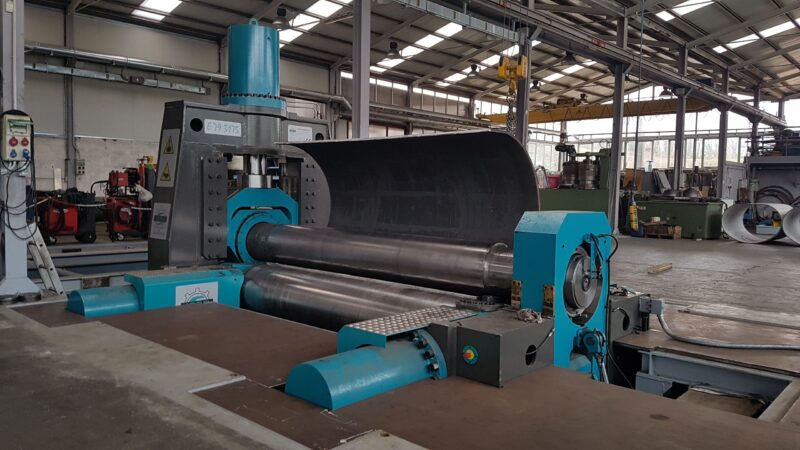
The 3 roller bending machine for precise and efficient metal sheet forming has become a cornerstone in metal fabrication, skillfully blending the legacy of traditional craftsmanship with the demands of modern industrial manufacturing. Its ability to shape metal sheets with precision and efficiency has made it indispensable across many sectors, from shipbuilding to aerospace and beyond. In this article, we will explore the machine’s historical development, technological advancements, broad industry applications, sustainability initiatives, and global market trends that continue to drive innovation and demand.
- Historical Context of the 3 Roller Bending Machine
- Technological Progress and the 3 Roller Bending Machine
- Versatility of the 3 Roller Bending Machine in Legacy and Modern Industries
- Sustainability and Efficiency in the 3 Roller Bending Machine
- Global Market Demand for 3 Roller Bending Machines
Historical Context of the 3 Roller Bending Machine
The 3 roller bending machine has its roots in the early days of industrialization, when metalworkers sought reliable methods to roll and shape metal sheets evenly. The earliest models were manual, relying heavily on the operator’s skill to crank rollers and form curved shapes. Despite their simplicity, these machines represented a major step forward in metalworking efficiency compared to hammering or hand-bending.
As industrial processes evolved, the machine incorporated hydraulic power systems, increasing the bending force and enabling operators to work with thicker and stronger materials. This transition from manual to hydraulic marked a significant leap in productivity. Later, the addition of electrical controls allowed for more precise adjustments and repeatable bends. The basic design of three rollers arranged to gradually shape metal has endured for over a century, proving its timeless effectiveness.
Technological Progress and the 3 Roller Bending Machine
In recent decades, the 3 roller bending machine has undergone a technological transformation, integrating CNC (Computer Numerical Control) systems and servo motors. These innovations have revolutionized metal bending by enabling operators to program complex bending sequences that machines execute with minimal supervision.
The introduction of servo-driven rollers offers smoother and more energy-efficient operation compared to traditional hydraulic systems. Advanced sensor technologies now measure material thickness and hardness in real time, allowing the machine to automatically adjust roller pressure. This capability not only improves bending accuracy but also reduces the risk of damaging expensive or delicate materials. Industries like aerospace and automotive have especially benefited from these advancements, where precision is critical and tolerances are often measured in microns.
Versatility of the 3 Roller Bending Machine in Legacy and Modern Industries
The versatility of the 3 roller bending machine is one of its greatest strengths. Historically, it was a mainstay in heavy industries such as shipbuilding, boiler manufacturing, and pipeline construction, where cylindrical and conical metal shapes are essential. Today, it has expanded its reach to newer sectors, including renewable energy, architectural design, and artistic metal fabrication.
For example, modern wind turbine towers require precisely bent steel plates to ensure structural integrity and aerodynamic efficiency. Similarly, architects use the 3 roller bending machine to create curved façades and structural components that blend aesthetics with functionality. The machine’s ability to handle a wide range of metals—from mild steel and stainless steel to exotic alloys like titanium—makes it invaluable for diverse manufacturing challenges. Its adaptability supports fabricators across both heavy industry and creative fields.
Sustainability and Efficiency in the 3 Roller Bending Machine
With sustainability becoming a priority, manufacturers have focused on improving the energy efficiency of the 3 roller bending machine. Innovations such as energy-saving motors, precise control systems, and IoT-based predictive maintenance reduce power consumption and minimize waste.
Accurate bending reduces material scrap and rework, contributing to leaner production processes. Furthermore, environmentally friendly hydraulic fluids and recyclable machine components reflect the industry’s shift toward greener manufacturing practices.
Global Market Demand for 3 Roller Bending Machines
The global market for 3 roller bending machine is expanding steadily, driven by infrastructure development and industrial modernization. Emerging economies in Asia-Pacific require durable, high-capacity machines for construction and energy projects, while manufacturers in Europe and North America focus on high-precision applications.
Industry 4.0 integration is a key trend, with companies seeking machines compatible with digital manufacturing ecosystems. This demand fosters continuous innovation, pushing manufacturers to develop smarter, more efficient machines to stay competitive.
From its early manual iterations to today’s CNC-driven, smart machines, the 3 roller bending machine has proven its lasting value in metal fabrication. Its combination of robust design, technological innovation, versatility, and sustainability ensures it remains essential across industries worldwide. As manufacturing challenges grow more complex, the 3 roller bending machine continues to evolve, delivering precision, efficiency, and adaptability to meet the needs of the future.